
Getting found on Google doesn’t have to be complicated or expensive. With the right foundation, even a small local business can rank above much larger competitors. Here are 7 practical tips you can start applying right now.
1. Start with keyword research
Before writing a single word, figure out what your customers are actually searching for. Tools like Google’s autocomplete, Answer The Public or Ubersuggest help you find phrases your target audience uses — often more specific than you’d expect.
Example: instead of “hairdresser Amsterdam”, people search for “hairdresser Amsterdam Oud-West open Sunday”.
2. Optimise your Google Business Profile
If you serve local customers, your Google Business Profile is your most powerful free SEO tool. Make sure:
- Your name, address and phone number are correct and consistent
- You’ve chosen the right category
- You have photos (ideally recent and professional)
- You actively collect and respond to reviews
A complete, well-maintained Business Profile significantly increases your chances of appearing in the local “map pack” — the three results that appear above regular search results.
3. Write pages for specific services
Don’t put all your services on one page. Create a separate page for each service, optimised for specific keywords.
- “Web design for restaurants in Amsterdam” beats “web design”
- “Emergency plumber Rotterdam” beats “plumber services”
Each page should answer: what do you offer, where, and why are you the best choice?
4. Focus on page speed
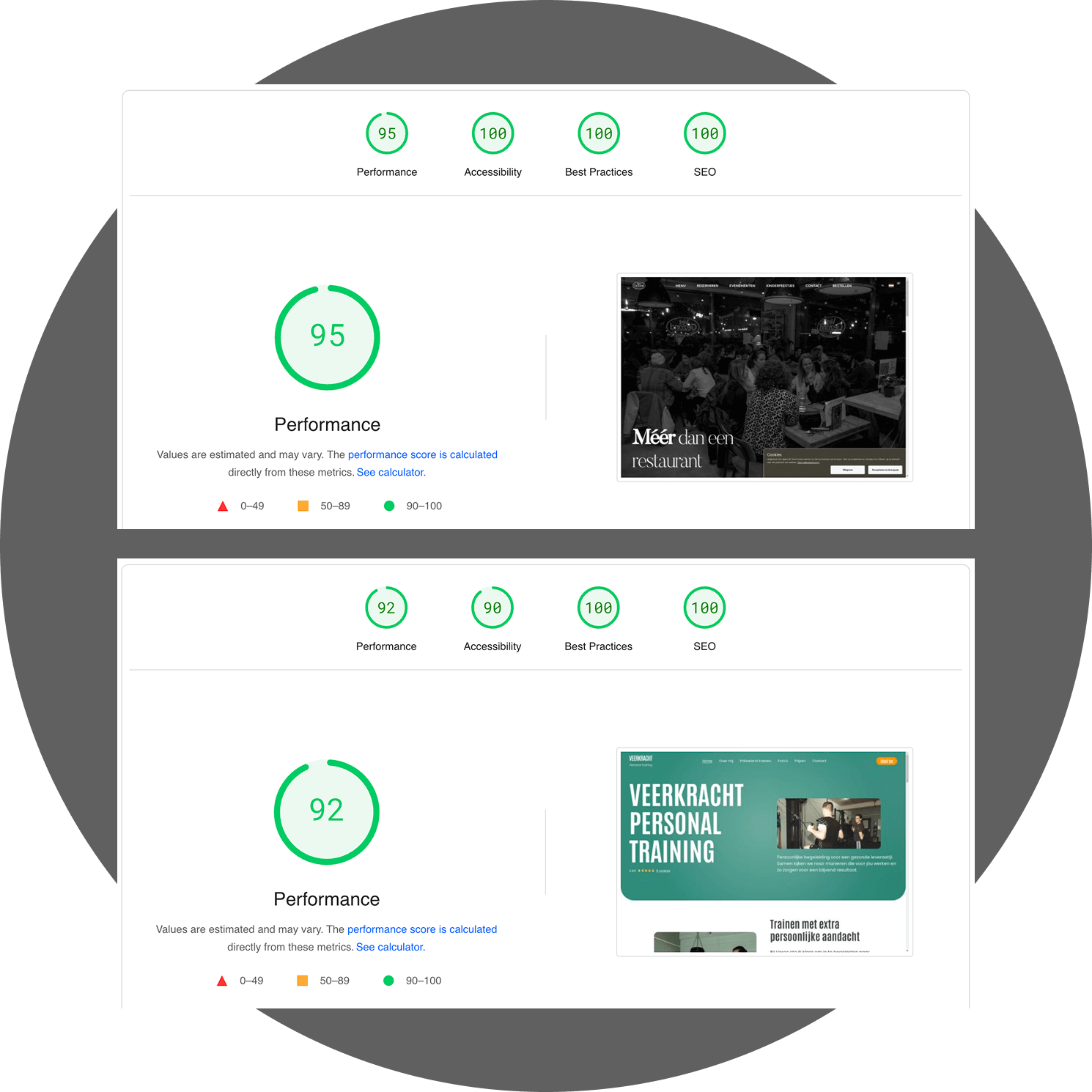
Google uses Core Web Vitals as a ranking factor. A slow website doesn’t just frustrate visitors — it directly harms your rankings.
Check your score via PageSpeed Insights. Common causes of a low score:
- Unoptimised images (convert to WebP, compress)
- Too many unnecessary scripts
- A heavy page builder like Elementor
A website built with Astro or properly configured Webflow scores 90+ by default.
5. Build internal links
Linking between your own pages helps Google understand your site structure — and spreads “authority” to important pages.
Write a blog post about topic X? Link to your relevant service page. Have a service page? Link to related blog posts or case studies.
This simple tactic is often overlooked but has a measurable impact.
6. Get backlinks from relevant sources
A backlink is a link from another website to yours. Google sees these as “votes of confidence” — the more quality backlinks you have, the more trustworthy your site appears.
Good starting points:
- Local directories (industry associations, chambers of commerce)
- Guest articles on industry blogs
- Partnerships with complementary businesses
- Your suppliers or clients linking to you
Quality beats quantity. One link from a reputable site is worth more than 50 from irrelevant directories.
7. Publish content consistently
A blog or knowledge base does two things: it attracts new visitors via long-tail keywords, and it signals to Google that your site is alive and active.
You don’t need to write every week. Even one solid, well-researched article per month makes a difference over time.
Focus on answering questions your customers actually ask — not on what you think is interesting.
SEO is a marathon, not a sprint. But with these basics in place, you’ll already be ahead of most of your local competition.
Want to know how your website currently scores? Get in touch and I’ll give you a free audit.